Carrera convectors
Water and electric convectors of our own production — six mounting types, lengths from 1000 to 3000 mm, non-standard sizes to project.
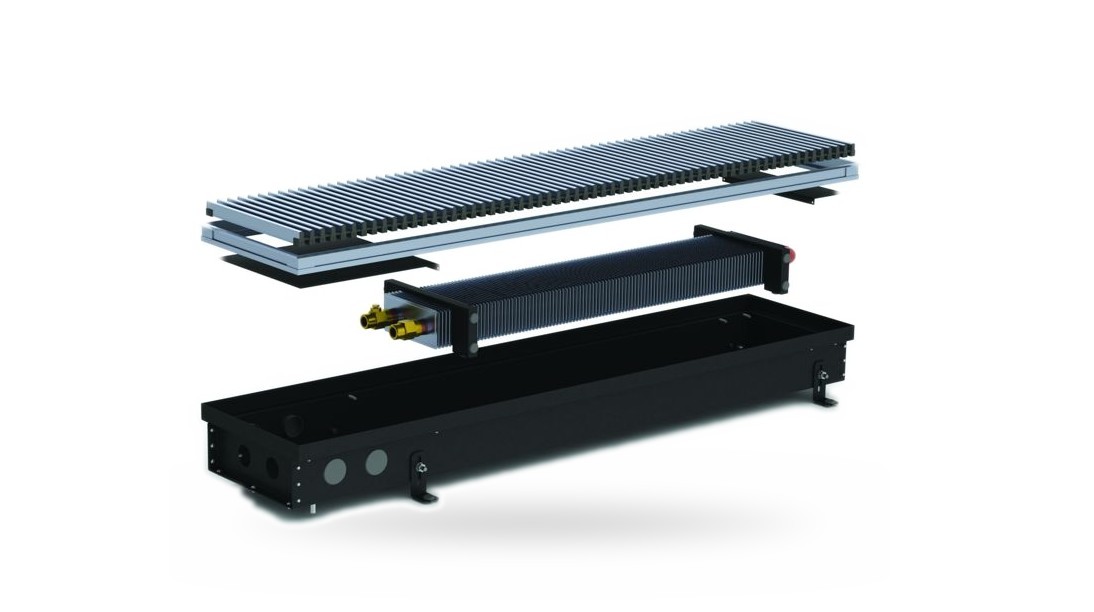 01 · Into the screed · 65–120 mmIn-floorThe casing in the screed, the grille flush with the floor. 6 series 65–120 mm high.
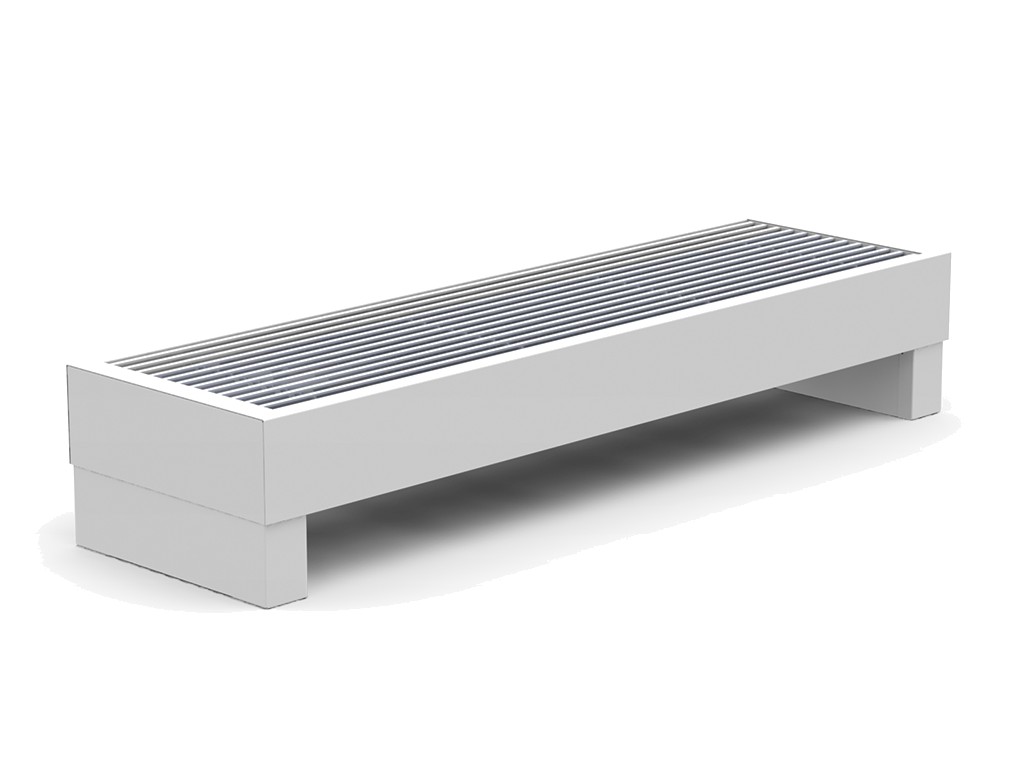 02 · On legs · no screedFloor-standing FRHThey stand on legs by the glazing. For a finished floor, without a screed.
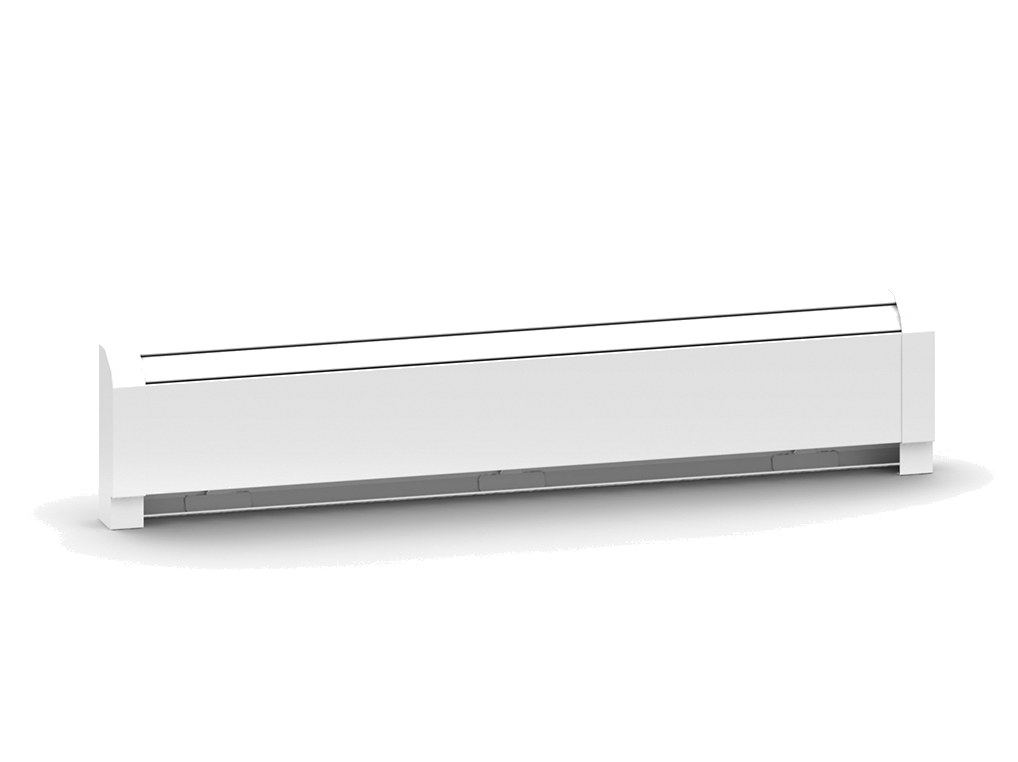 03 · BR 18 / BR 21 · along the wallSkirting BRA low unit along the wall: BR 18 and BR 21, installation without a screed.
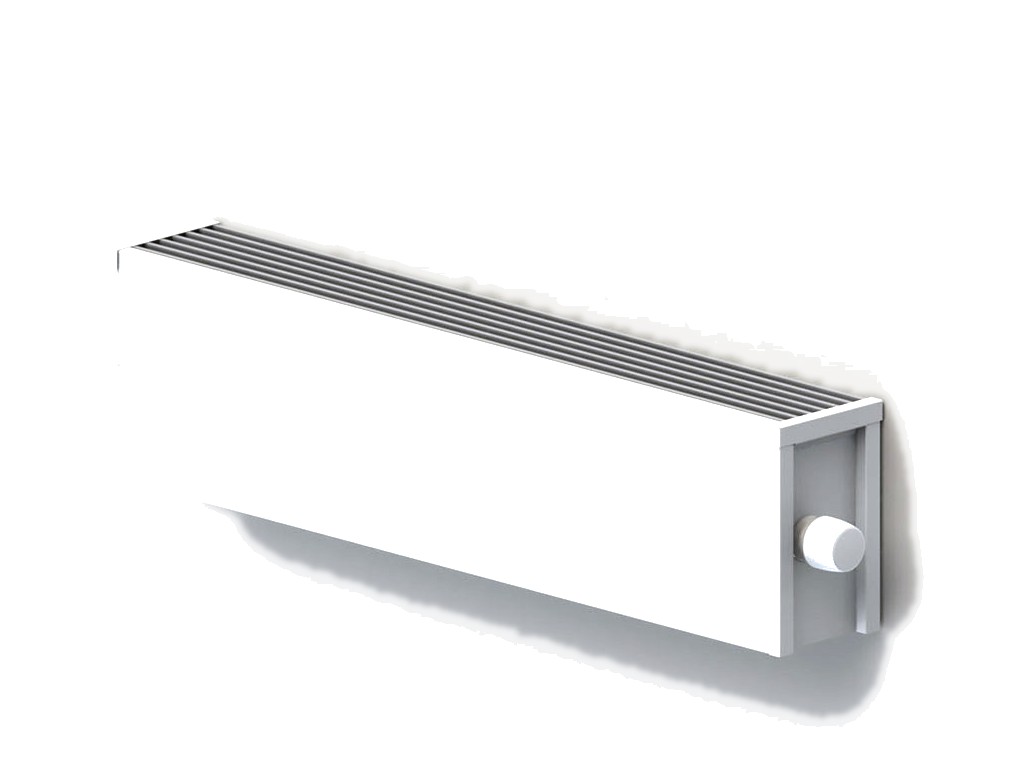 04 · WR / WRV · local heatingWall-mounted WRLocal heating: WR with natural convection and WRV with a fan.Availability — check with a manager
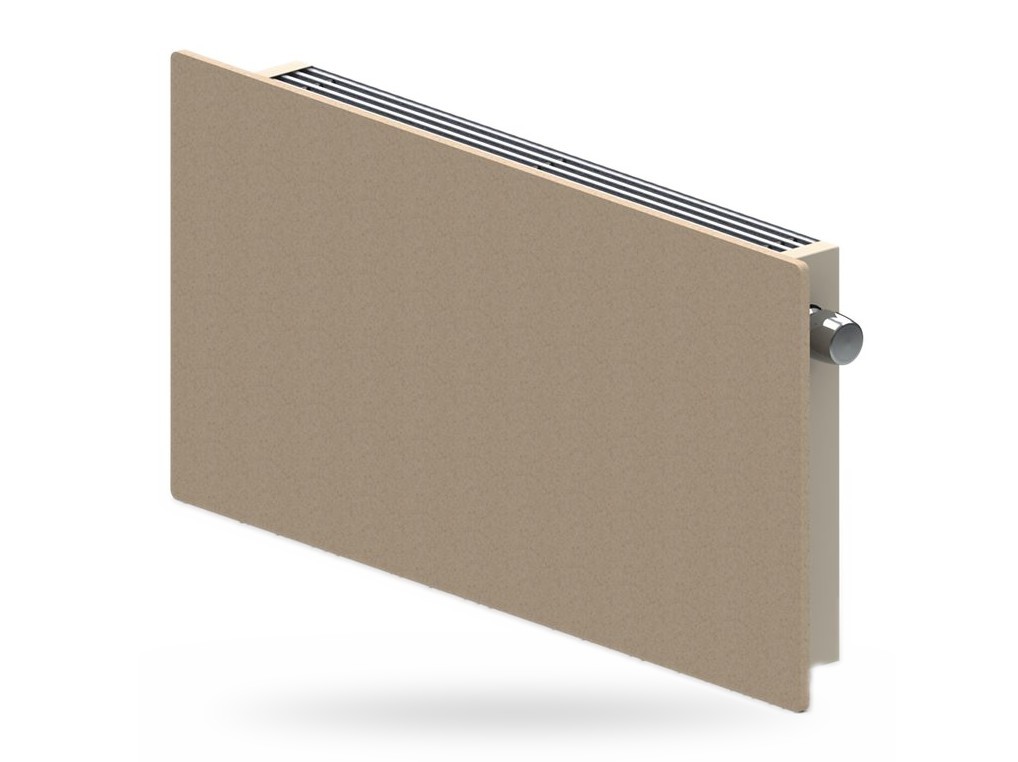 05 · Stone finishStoneDesign convectors finished with decorative stone.Availability — check with a manager
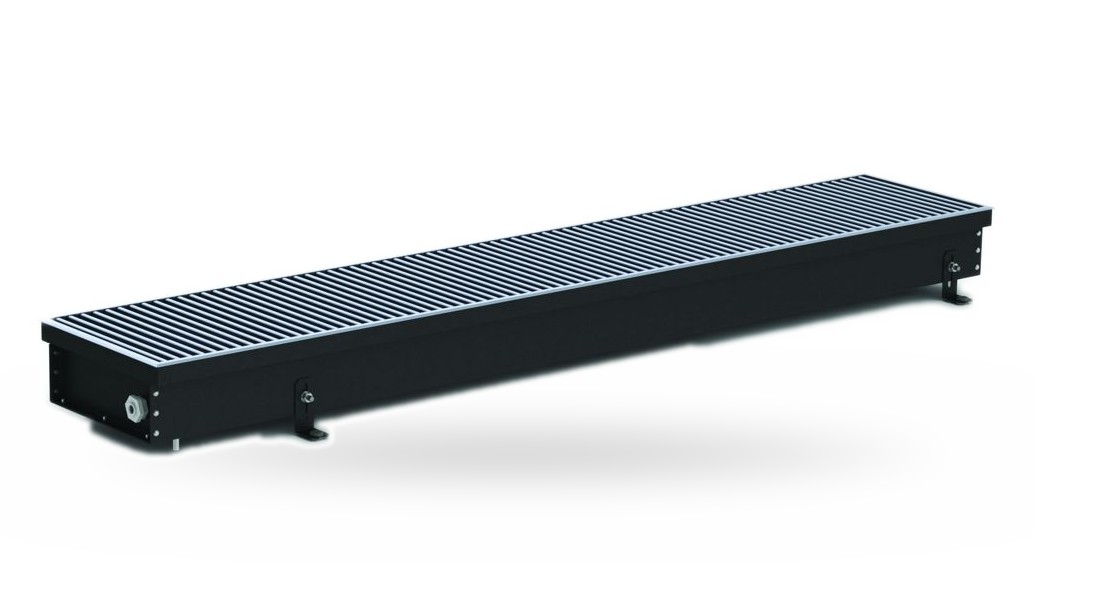 06 · 220 V · no boilerElectric SEPowered from 220 V, without a boiler: heating elements in aluminium plates.
For convectors with a fan — 24 V thermostats and power supplies. The kit is selected together with the units.
Which type to choose: three questions in order
The type is determined by the floor condition, the building’s heating system and the place where the convector can stand. The colour, grille and casing are then chosen for the type that physically fits.
- The screed isn’t poured yet or can be deepened from 65 mm? Take an in-floor convector: only the grille is visible on top, and under floor-to-ceiling glass there is no wall for a radiator.
- Is the floor already finished? Under the window goes a floor-standing FRH on legs, along the wall runs a skirting BR. Both are installed without a screed.
- No water heating? That leaves an electric SE: 220 V heating elements, no connection to a boiler at all.
Wall-mounted WR — for local top-up heating on the wall. Stone is chosen when the unit should become part of the interior.
Six types in one table
| Type | Installation | When to choose | Dimensions | Output |
|---|---|---|---|---|
| In-floor | Into the screed flush with the floor, grille on top | Screed not yet poured; floor-to-ceiling glazing | Casing height 65, 90, 105, 110 or 120 mm; casing width 180–400 mm; length 1000–3000 mm | 251–2019 W with natural convection, up to 9452 W with a fan (85/75) |
| Floor-standing FRH | On legs by the window, no screed | Renovation is done, the casing can’t be recessed | Width 148 mm (FRH) or 290 mm (FR2H), height 175 mm, length from 1000 mm | 722–3204 W (90/70) |
| Skirting BR | Along the wall instead of a skirting board; corners, joints and end caps are ordered with the units | Renovation, perimeter routing | Width 60 mm, height 180 mm (BR 18) or 210 mm (BR 21), length 1000–2500 mm | 379–1712 W (90/70) |
| Wall-mounted WR / WRV | On the wall; to order, from 1 to 3 heat exchangers | Local heating where floor solutions aren’t needed | Lengths 1000–2000 mm in the series table | WR 681–1707 W, WRV up to 3099 W (90/70) |
| Stone | FRH Stone stands on the floor, Stone Panel hangs on the wall | The unit is part of the interior | Size, colour and pattern are part of the model designation | SP / SPR panels 1042–2625 W (90/70) |
| Electric SE | A ready unit at 220 V, without a water system | No water heating | Height 90 mm, length 1000–2000 mm | 330–700 W |
The modes in the table differ: 85/75 for in-floor, 90/70 for FRH, BR, WR and Stone. So figures from different rows are compared only as orders of magnitude, not as “this unit is stronger”.
What the coolant mode does to the output
The catalogue figure corresponds to a hot coolant. A heat pump usually runs at 45/35, and there natural-convection units give only a fraction of what is stated. For a one-metre unit it is immediately visible:
| Unit, 1000 mm | Base mode | 45/35 | Remaining |
|---|---|---|---|
| M/C 65, natural convection, 1 heat exchanger | 251 W (85/75) | 82 W | ≈33% |
| S/C 90, natural convection, 1 heat exchanger | 303 W (85/75) | 101 W | ≈33% |
| MV 65 with the fan at 100%, 1 heat exchanger | 1167 W (85/75) | 493 W | ≈42% |
| FRH | 722 W (90/70) | 123 W | ≈17% |
| BR 21 | 523 W (90/70) | 97 W | ≈19% |
A fan holds more but pays with noise: in the MV 65 it gives 19.4–22.8 dB at 30% speed and 45.0–51.0 dB at 100%. In detail about this mode — in the review of the convector on a heat pump, about noise — in the article on the fan, output and consumption.
When a type is not suitable
- In-floor: the screed is poured or thinner than 65 mm. There is nowhere to lay the casing, and redoing the screed for it is costly.
- Floor-standing FRH: the system is low-temperature and the window is large. At 45/35 a one-metre FRH gives 123 W, and without a reserve of length the room will stay cold.
- Skirting BR: corners, joints and end caps were not ordered with the units. The perimeter loop can’t be assembled without them, and installation will stall.
- Wall-mounted WR: the glazing goes to the floor. Under such a window there is simply no wall.
- Electric SE: the building has water heating with spare capacity. A water S/C 90 of the same height gives 303–770 W over lengths 1000–2000 mm (85/75, natural convection), SE — 330–700 W, but without pipes or a boiler. What decides is whether there is anything to connect to.
What to check before choosing a type
- Measure the actual screed depth or the full height of the layer under the unit. What to agree before pouring the screed — a separate list.
- Find out the coolant mode: 85/75, 65/55 or 45/35. If the heat source is a heat pump, take the figures from the 45/35 row.
- Find out whether water gets onto the floor: a pool, SPA, winter garden, greenhouse. There you need the Hydro series with drainage, not an ordinary one.
- For a skirting loop, count the room’s corners.
- Write down the glazing length: the unit is placed along the whole glass. An approximate selection is given by the calculator, the final figures are calculated by an engineer.
Which convector to choose if the floor is already finished?
Floor-standing FRH or skirting BR: they don’t need a screed. FRH is placed under the window, BR runs along the wall. On a heat pump their output drops sharply, so the mode is agreed before ordering.
How does in-floor differ from floor-standing?
The in-floor one is set into the screed at the construction stage, and only the grille is visible in the room. The floor-standing FRH stands on legs and is installed in a finished room, but it takes up space by the window.
Which type for a heat pump?
The one that fits into the floor, but with a fan or a reserve of length. Natural convection at 45/35 gives about a third of the 85/75 output: in the M/C 65 at a metre that is 82 W versus 251.
Are there sizes outside the standard range?
Yes, non-standard sizes are made to project. The standard lengths of in-floor units are from 1000 to 3000 mm. The limits and the effect on output are clarified by an engineer.
What to choose if there’s no water heating?
The electric SE series: 220 V heating elements are built into aluminium plates, and the unit is not connected to a boiler. There is also a floor-standing electric option, FRHE, for cases where there is no screed.